Self-Cleaning Surfaces
Smart Material Solutions (SMS) has developed nanopatterned self-cleaning surfaces that reduce the adhesion and buildup of dust and other particulates, including dirt, sand, pollen, potash, and similar contaminants. The technology can help maintain the performance of solar panels, sensors, thermal-control surfaces, mining equipment, and other hardware exposed to particulate contamination.
SMS’s self-cleaning surfaces have demonstrated a >73% reduction in dust adhesion force compared with a smooth film, leading to <5% dust coverage on vertically mounted surfaces.
SMS combines engineered nanopatterns with tailored surface chemistry to create dust-mitigating and anti-fouling surfaces that reduce particulate adhesion. As shown in the video below, dust readily falls from SMS’s nanopatterned surface while remaining adhered to an untreated surface.
Reduced Particulate Adhesion
At a high level, SMS’s nanopatterns reduce the contact area between particles and the underlying surface, helping decrease adhesion, as discussed in our blog on nanostructured surfaces for dust mitigation on the Moon. This weaker adhesion allows dust and other particulates to be removed more easily by gravity, wind, vibration, and rain.
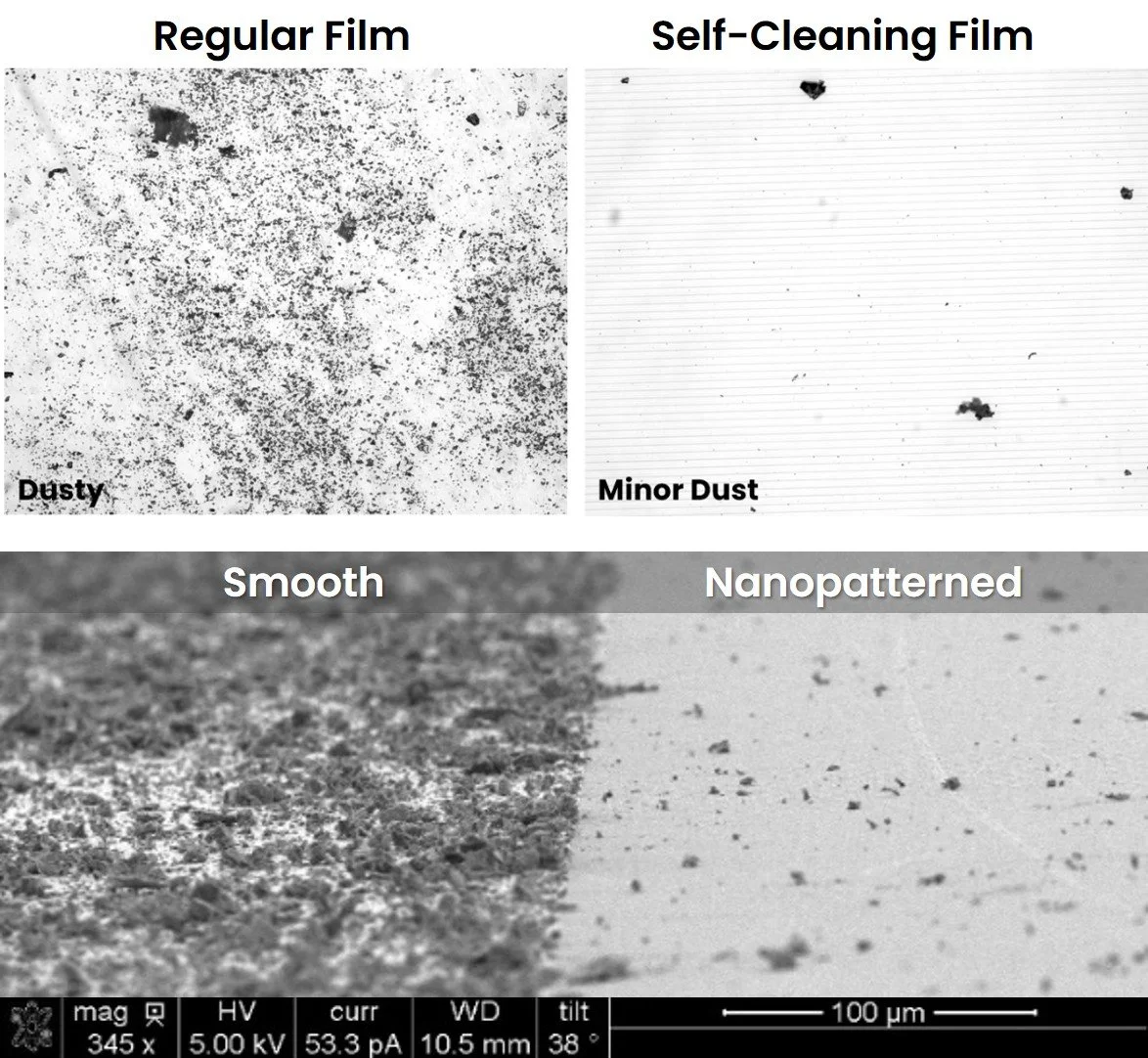
Comparison of dust adhesion to smooth (left) and nanopatterned self-cleaning surfaces (right), shown by optical microscopy (top) and SEM (bottom).
The effect can be seen across multiple length scales, as seen in the figure on the right. The optical microscopy images at the top compare two separate samples exposed to the same dust, while the higher-magnification scanning electron microscopy (SEM) image at the bottom shows a single sample with a smooth region on the left and a nanopatterned region on the right. In both cases, the nanopatterned self-cleaning surface retains far less dust.
Beyond dust, preliminary experiments have demonstrated decreased adhesion of potash on mining equipment, showing the potential for these particulate-repellent surfaces to reduce buildup in demanding industrial environments.
Applications
SMS’s dust mitigation technology can be tailored for applications where particulate buildup reduces performance or increases cleaning and maintenance requirements. Potential applications include:
Solar panels and other optical surfaces
Cameras and sensors
Thermal-control surfaces and radiators
Mining and industrial equipment
Vehicle surfaces, optics, sensors, and thermal-management hardware operating in dusty or desert environments
Spacecraft and lunar surface hardware
SMS has developed dust-mitigating surfaces for solar panels and high-emissivity radiators, as well as surfaces designed for demanding terrestrial, industrial, and space environments.
From Lunar Dust to Terrestrial Applications
SMS originally developed this dust-mitigating technology to reduce lunar regolith contamination under a NASA SBIR program in collaboration with Professor Chih-Hao Chang at the University of Texas at Austin.
Since then, SMS has expanded the technology toward Earth-based applications where dust and particulate buildup create similar challenges. These include solar panels that experience soiling, mining equipment exposed to potash, and other equipment operating in dusty or desert environments.
A sample of SMS’s patterned nanocoating is also planned for flight aboard Astrolab’s FLIP rover on Astrobotic’s Griffin-1 mission.
Materials, Integration & Scale-Up
SMS can tailor self-cleaning surfaces to the requirements of a particular application. The technology has been demonstrated using a range of materials including polyimide, polycarbonate, PET, glass, and metal substrates, with options including both optically clear and hazy surfaces.
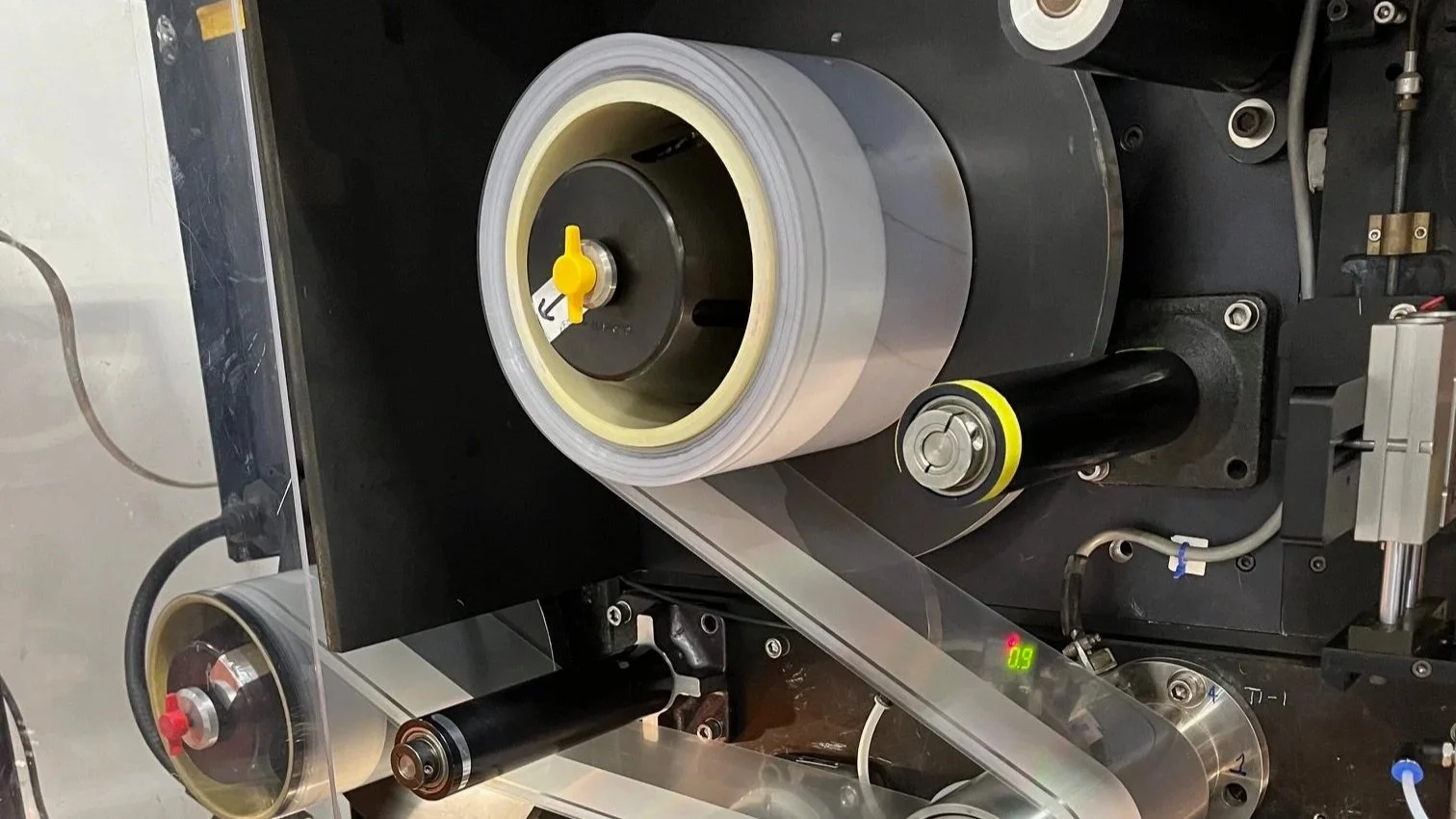
Roll-to-roll fabrication of SMS dust-mitigating material with both hazy and optically clear regions.
Depending on the application, SMS can provide the technology as an adhesive-backed film, a surface coating, or another configuration designed for integration with the customer’s hardware.
The technology is also compatible with scalable roll-to-roll fabrication. The photo on the right shows a dust-mitigating film with both hazy and optically clear regions being produced on a roll-to-roll platform.
Have a Particulate Fouling Problem?
SMS works with customers to evaluate particulate-fouling challenges and develop self-cleaning surfaces tailored to specific materials, contaminants, and operating environments.
If dust or particulate buildup is affecting the performance or maintenance of your equipment, contact us if you’re interested in the co-development or testing of our self-cleaning surfaces for your application on Earth or beyond.